

Onion
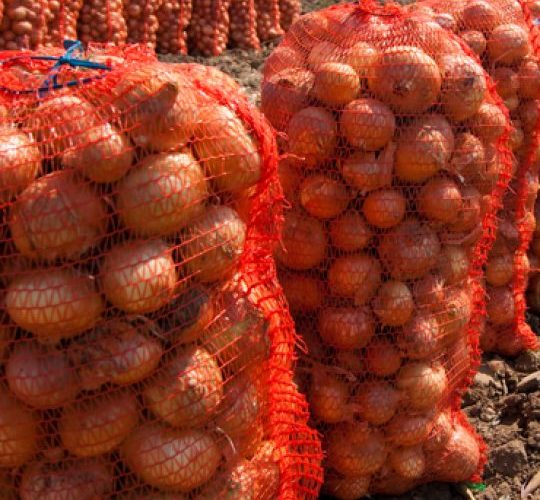
Onion (Allium capa L.) is one of the important vegetables widely used in all households. Pakistan attained the 8th position globally with 2.25% share in world onion production (FAOSTAT, 2011). There are several uses for onions including, pickling, chutney, sauces and dehydration. The onion is a hardy, cool-season biennial crop but is usually grown as annual crop. The onion has narrow, hollow leaves and a base which enlarges to form a bulb. The bulb can be white, yellow, or red and require 80 to 150 days to reach harvest. Recent research has suggested that onions in the diet may play a part in preventing heat stroke, disease and other ailments. Onion bulb is rich in phosphorus, calcium and carbohydrates. The pungency in onion is due to a volatile oil known as allyl-propyl disulphide.
Climate
Onion is a cool season crop, its optimum temperature for seed germination ranges from 20-25 °C, early growth stages before bulbing require 13 to 20 °C and bulb development needs 16 to 25 °C. Best growth and quality is obtained when the temperature is cool during the early development and warm near maturity. A dry atmosphere at harvest is desirable to obtain satisfactory curing of the bulbs. The onion is fairly resistant to frost injury, but not immune.

Soil Conditions
Onion can be grown on a wide range of soils preferably sandy rich loam, well-drained containing sufficient organic material to retain soil moisture for proper growth. Soil with pH from 6 to 7 is suitable for optimum crop growth. Hard soils induce the bulbs to be small and irregular in shape. Adequate quantity of manure and fertilizer is necessary for successful onion production.
Varieties
Onions start bulb formation when the day length is of the proper duration and different varieties of onions require different day lengths to initiate bulbing. In general, most common varieties fall into one of two classes, long-day (for northern latitudes) and short-day (for southern latitudes). For this reason, onion varieties that are grown in the South are not adaptable to the North and vice versa. Onion varieties grown in Pakistan are given below:

Seed Rate
2-3 kg per acre seed is required for Nursery production but if the germination rate of a variety is very good then 1 kg is enough for per acre.
Time Of Sowing, Transplanting And Harvesting:
Province-wise nursery sowing, transplanting and harvesting times of onion are given below:

Land Preparation
Proper land preparation is very important to ensure a uniform stand and higher onion bulb yield which can be achieved following below mentioned practices. The soil should be deep turned at least three to four weeks prior to planting, using a moldboard plough. The soil should be ploughed to the depth of 15 to 20 cm and one or two planking are sufficient to get good tilth and leveled seedbed. Land must be leveled in order to irrigate the plants properly. Although onion has limited root system but is very responsive to manures and commercial fertilizers.
Production Methods
- Sowing seed directly in the field.
- Sowing in a seedbed from which the plants are transplanted later to the field.
Fertilizer Requirement
A supplementary dose of one bag of ammonium sulphate per acre should be applied one month after planting. Another dose of one bag of ammonium sulphate may be applied at the time of bulb formation. Generally excess of nitrogen causes onion bulbs to become less firm. Similarly, late application of nitrogen as top-dressing should be avoided, as it causes thick-necked bulbs. A good combination of potash and phosphate promotes firmness of bulbs and regular ripening.
Nitrogen
Nitrogen, especially in nitrate form, is extremely leachable. If too little nitrogen is available, onions can be severely stunted and more susceptible to diseases. High nitrogen application rates produce a succulent plant that is more susceptible to the production of flower stalks. Onions highly fertilized with nitrogen do not store well. Excess nitrogen late in the growing season delays maturity and causes doubling.
Phosphorus
Phosphorus is essential for rapid root development. It is found in adequate levels in most soils but is not very available at low soil temperatures. Because of these factors, it is best to band at least part of the phosphorus about three inches below and to the side of the transplant at setting.
Potassium
Potassium if applied in a concentrated band near the plant can result in damage and stand reduction. Potassium is also subject to leaching from heavy rainfall or irrigation. Apply potassium in small amounts throughout the growth of onions.

Nutrient Deficiency Symptoms Of Onion
Nitrogen
- Leaves are light green
- Older leaves die, showing bleached yellow color
- Leaves are small
Phosphorus
- Older leaves wilt
- Tip die back
- Green areas are mottled
- Dead leaves turn black
Potassium
- Older leaves first show slight yellowing
- Leaves wilt and die; drying begin at tips of older leaves
- Poor bulb formation

Irrigation
An onion continues to produce new roots (three or four per week) throughout the entire growing season as older roots die. Root growth is most active during early plant growth. Proper soil moisture is critical for continuous root growth and for supplying the needs of the foliage and bulb. Make sure good soil moisture exists before and after seeding, transplanting or setting sets. Prior to emergence and during the first three weeks of seedling growth, it is essential that adequate moisture be maintained in the top three to four inches of the soil. The onion has a shallow root system, with most of its roots in the top 12 inches of soil. First irrigation is given immediately after sowing and transplanting. Thereafter, onions are usually irrigated after ten days interval which can be increased or decreased according to climatic conditions. Irrigation must be discontinued before neck fall, to allow the bulbs to ripen off. Over-watering just before harvest can increase disease, splits and doubles.
Harvesting
Onion is harvested depending upon the purpose for which the crop is planted. Onion crop is ready for harvesting in five months for dry onion. However, for marketing as green onion, the crop becomes ready in three months after transplanting. When the bulbs developing from the leaf bases of onions are fully formed, the leafy green tops begin to yellow and eventually collapse at a point a little above the top of the bulb, leaving an upright short neck. When the tops “go down” in this way, the bulbs are ready for harvesting. Because all the onions in a crop do not mature at the same time, large-scale commercial growers harvest them when about half the tops have gone down.
Insect/Pest Of Onion
Onion Maggots
Onion maggots are attracted to soil that has a high level of decomposing organic matter. Before planting or transplanting onions, deep-turn crop residue to help avoid this problem. Wet years favor onion maggot infestations. The maggots attack weak plants and early plantings. Small white maggots up to inch long bore through the underground portion of the leaves and into the bulbs, causing the plants to become flabby and turn yellow. Large bulbs that are not completely destroyed will rot in storage. The adult onion maggot is a fly similar to the common housefly. However, the adult onion maggot is smaller with straighter, longer wings. Good land sanitation is necessary.
Onion Thrips
Onion thrips (Thrips tabaci) are small, yellowish sucking insects, which feed on the foliage of onion plants causing whitish blotches and dashes on the leaves. Thrips can be found in greatest numbers between the leaf sheaths and the stems of onions. The tender central leaves become curled and deformed and the outer leaves turn brown at the tips. Thrips are most injurious during dry weather. The pest is very injurious at the time of flowering and impairs seed production. Suitable insecticide should be sprayed at weekly interval as soon as thrips appear.
Diseases
Damping Off
Damping off is the first disease that can affect growing onions. Symptoms of damping off are seedling wilts and collapse from rot at or just below the soil line. Damping off occurs in seed beds and is caused by a group of soil-borne fungi. It is often related to weather conditions. Prevention is the best approach to controlling damping off. Avoid over irrigation. Spray the crop with Dithane M-45 at fortnightly interval.
Neck Rot
The neck rot (Botrytis alii) is a disease of mature onion bulbs found in all regions where onions are stored. The fungus only attacks onions that have been injured or wounded during harvesting; therefore, bruising during harvest should be avoided. Thick-necked onions should not be stored since they are slow to cure and succumb quickly to neck rot.
Downy Mildew
The downy mildew of onion (Peronospora destructor) is a fungal disease of onion grown in cool moist conditions. The systemic infection occurs when the plants are grown from a diseased bulb. In this case the plants remain stunted, become distorted and pale green. In humid weather, fungus develops as white or purplish downy growth over the leaf surface but in dry weather, only white spots are seen. Older leaves are attacked first and then infection spreads to sheath but new young and central leaves remain healthy. The entire plant is not killed but only undersized bulbs are produced. Dithane M-45 or any other copper based fungicide can be used to control the disease. It is easier to prevent infection than to cure it. The precautionary measures include crop rotation with a 4 year break in onion cultivation, planting onion at appropriate site, weed control and removal of infected plants from the field.
Purple Blotch
Purple blotch (Alternaria porri) is a serious fungal disease of onion that occurs at temperature range of 25-30 0C with 70-90 percent relative humidity. The leaves and flower stalks show whitish flecks with purple color center, which on further development form dead patches. Spray the crop with Dithane M-45 at fortnightly interval before appearance of the disease. Keep the crop free from the weeds.