

Chili
Introduction
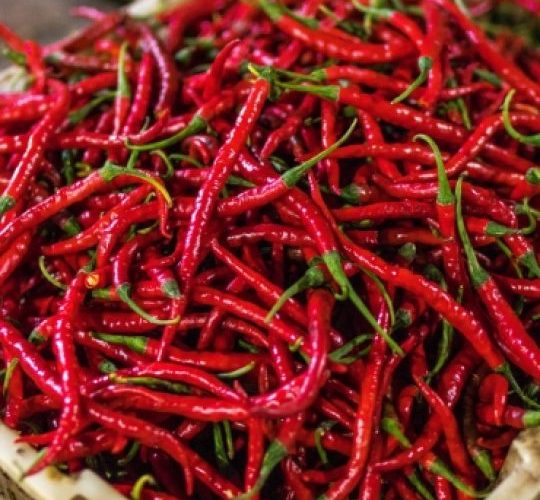
Chilies are produced seasonally but consumed throughout the year. The pods are marketed both in green and red or natural form. Its cultivation involves heavy labor and capital inputs. There exists a great scope for its export. Chili peppers are widely used in many cuisines as a spice to add heat to dishes. The substances that give chili peppers their intensity when ingested or applied topically are capsaicin and related compounds known as capsaicinoids. Chili peppers originated in Mexico.
Climatic Conditions
Chilies require warm and humid climate for growth and dry weather during maturity. The crop comes up well in tropical and sub-tropical regions but it has a wide range of adaptability and can withstand heat and moderate cold. It can be grown over a wide range of altitudes from sea level up to nearly 2,100 meters. It requires 25-32 ℃ temperature range. Heavy rainfall leads to rotting of the crop. Un-favorable temperatures lead to bud blossom and fruit drops.
Seed Rate:
200 g/acre for open variety; 80-100 g/acre for hybrids

Nursery Development
Nurseries are raised on well-prepared, metre wide and three meter long strip. Before broadcasting the seeds, straws or farm yard manure is burned on the strips after which seeds are broadcast and pressed in the soil and covered with a thin layer of soil. These are then covered with layers of straws supported by wooden sticks with water application in the morning and evening till the seeds germinate. After germination straw is removed and water is applied after every 4-5 days. Within six weeks seedlings become ready for transplanting.
Soil Conditions
Chilies are grown on soils with light sands to well drained clay. Silty and clay loam soils are better, while water-logged and alkali is not suitable. Soils selected are prepared thoroughly for getting good yields. As roots of chillies go one foot deep, therefore, deep ploughing is necessary. Two ploughing with mould board plow followed by global plow are done, levelling the soil for even distribution of water and fertilizer. About 30-40 cart loads of well rotten farm yard manure per acre are added one month before transplanting the chilies.
Land Preparation
Proper land preparation is very important to ensure a uniform stand and higher chili yield which can be achieved following below mentioned practices. Deep-turn soil at least three to four weeks prior to planting, using a moldboard plough. The soil should be ploughed to depth of 15 to 20 cm and one or two planking are sufficient to get good tilth and leveled seedbed. Land must be leveled in order to irrigate the plants properly. Although chili has limited root system but is very responsive to manures and commercial fertilizers.
Transplanting Of Seedlings
After land preparation, ridges of one and half foot high and wide are prepared. Transplanting is done on both sides of the ridges and distance between each plant is maintained at one and a half foot. Care is taken to avoid plants on both sides of ridges to face each other as this leads to dense plant population causing hindrances in weeding, harvesting, spraying etc. Transplanting is preferable done in the evening, because in the morning seedlings cannot withstand noon temperatures. After transplantation two rounds of watering are applied so that plants develop roots. Subsequent irrigation is applied as per climatic conditions.
Duration Of Crop
Total duration of chili crop is 150-180 days. And seed germinate within 4-7 days.
Varieties Of Chilli

Fertilizers
Recommended fertilizer dose for chilies is one bag of DAP and one of potassium sulphate before sowing, and two to three bags of urea, one bag is applied after 20 days of transplanting and the second at flowering stage, and third, if necessary, at fruit setting.
Irrigations
After transplantation two rounds of watering are applied so that plants develop roots. Subsequent irrigation is applied as per climatic conditions.
Harvesting
Green chillies are picked early in the morning or in the evening. These are protected from the sun to avoid quality deterioration. Ripe fruits are harvested at frequent intervals. Retaining fruits for a long period on the plant causes wrinkles and colour fading. Soon after the harvest, the produce is heaped or kept in clean gunnies for one day for uniform colour development of pods. Sun-drying is necessary to ensure complete dryness. Levelled and compacted floor is made for drying. From the fifth day onwards, the produce is inverted on alternate days so that pods in the lower layers are brought up to ensure quick and uniform drying. To avoid microbial activity and aflatoxin production, the moisture in dried pods need to be brought down to 10 per cent.
Post-Harvest Practices
Since the produce is exposed to sun for 10-15 days in open yards, it is likely to get contaminated with foreign matter. This also results in poor colour for the product due to the bleaching effect of sun-rays. The produce can be dried within a period of 18 hours by using air drier for maintaining the temperature at 44-46°C. The method not only saves time of drying operation but also imparts deep red colour and glossy texture to the produce. Solar drier and tray drier can be used. While drying, the produce is covered with polythene sheets during night to avoid dew deposition and colour fading. Grading is done to remove defective and discoloured pods. Packing is done in gunny bags, or jute boras.
Pest Of Chili And Their Control
Fruit borer:
Caterpillars eat leaves of crop afterward they enter into fruit and cause heavy loss in yield management. Collect and destroy damaged fruits and grown up caterpillars. Set up pheromone traps for Helicoverpa armigera or Spodoptera litura at 5 Nos./acre. To control pod borers apply poison bait balls made up of bran-5 kg, Carbaryl-500 gm, Jaggery-500 gm and sufficient amount of water. If infestation of fruit borers is observed, spray Chlorpyrifos + Cypermethrin (Nurel-D/Amla) @30 ml+Teepol@0.5 ml in 12 Ltr of water with power sprayer. Spray with Emamectin benzoate 5% SG @4 gm/10 Ltr of water or Flubendiamide 20 WDG@6 gm/10 litre of water.
Fruit borer:
These are widely distributed pests observed throughout the world. It attacks several crops like potato, chili, beans, cotton, tobacco, cucurbit, castor, jute, coffee, lemon, citrus, blackgram, cowpea, pepper, tomato, sweet potato, mango, papaya, brinjal, guava. Nymphs and adults feed exclusively on the lower surface of the leaves. Infected leaves give cup shape appearance. Heavy infestation results in defoliation, bud shedding and drying of leaves.
If infestation of yellow mite & thrips is observed in field, spray of Chlorfenapyr@1.5ml/Ltr, Abamectin@1.5ml/Ltr are found effective. Mite is a serious pest and it may cause yield loss up to 80%. For effective control spray Spiromesifen 22.9SC@200ml/acre/180Ltr of water.
Aphid:
They attack mostly in winter month and later stage of crop. They suck sap from the leaf. They excrete honey like substance and develop sooty mold i.e blackish colour fungus on the calyx and pods thus deteriorate quality of product. Aphids also work as important insect vectors for chilli mosaic. Mosaic disease transmitted by aphids cause 20-30 percent loss in yield. To control, take spray of Acephate 75SP@5gm/Ltr or Methyl demeton 25EC@2ml/Ltr of water. Soil application of granular insecticides viz Carbofuran, Phorate@4-8kg/acre on 15 and 60 days after transplanting were also effective.