

Citrus
Introduction
Pakistan is blessed with a climate ideally suited to the farming of all kinds of fruits–succulent and rich in taste. Farmers have been developing new varieties of fruit by grafting one exotic variety upon another.
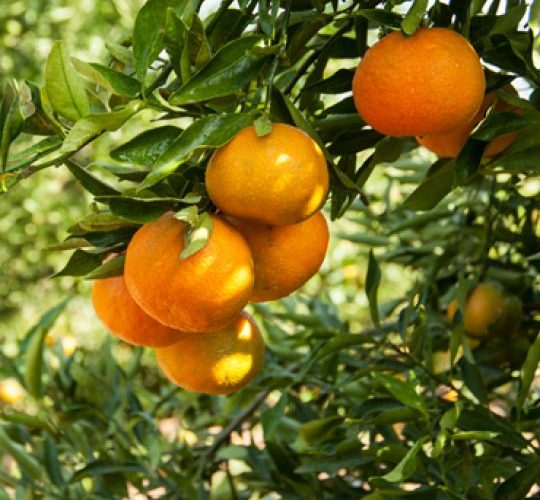
Season of Kino in Pakistan starts from December and last till April. Kinnow is very delicious in taste and if treated with proper fungicide and wax and careful handling and storage of Kinnow at about 4 Degree Centigrade can retain its freshness until 2 months. Pakistan is one of the few countries in the world where some of the varieties of fruits grown in cool temperate climate such as apples, pears, plums and cherries while in warm temperate climate such as apricots, grapes, pomegranates and melon and in tropical and subtropical climate such as bananas, mangoes, dates, guava and citrus so the fruits are usually available throughout the year.
Propagation
All the improved varieties are propagated by means of budding on rough lemons or sour orange. Rootstocks are generally grown through seed, T budding/T grafting are the usual method of citrus cultivars propagation. Budding may be done during spring (Feb-March) and autumn (August-October) when bark slip freely from both scion and stock. Bud should be selected from mature wood of productive and healthy trees. In sweet lime propagation through cutting is a common method.

Soil and Climate
Citrus trees can be grown on a wide range of soils, including deep sandy loam, loam and clay loam. However, they do not grow well in very heavy, clayey, sandy, and alkaline or water logged soils. Citrus fruits trees are grown in tropical and sub-tropical climate. Temperature is the main factor affecting, time of blooming, maturity, producing and fruit quality of citrus.
Pruning
At the time of transplanting the top portion should be balanced with the roots by removing some of the leaves, if necessary. Annual pruning is done to remove dried, diseased and those branches overcrowding the top of the tree. For a young citrus tree to have good frame work, no branches should be allowed on the main stem and two to four evenly spaced main limbs should be selected to provide a balanced frame work. In Pakistan however, no systematic pruning is followed except for removal of dried, diseased and unwanted twigs.
Water Management
The preferred method of irrigation is a basin round each tree the size of. There should be channels connecting basins so that irrigation of fruits trees can be independent of the intercropped area between the tree lines which have different water requirements. Growth sensitive periods to water shortage are flowering time (Feb/Mar), fruit setting (Apr/May).
Fertilizers and Manures
- Apply FYMs at the rate of 40 to 80 kg per tree during the winter season in Dec/Jan before flowering.
- Apply 3-4 kg SSP and 1.5 to 2 kg of Urea 15-20 days (Jan/Feb) before flowering.
- Supply a further amount of Urea of 1.5 kg per tree after fruit setting (Mar/Apr).
- If necessary 1.5 kg of Potassium Sulphate may be applied at the time of applying FYM.
- Watering is essential after each application of fertilizer.

Pests and Diseases
Aphids:
These are small brown colored insects. They suck the sap from the leaves and branches and cause great damage to trees and reduction of yield. Aphid attack is severe during Feb and April. Use Dizenon 40% or Eldrine 20%, 1 kg in 450 litres of water. Insecticides should not be applied within 6 weeks of marketing the fruit.
Citrus Leaf Minor:
This attacks the leaves. The attacked leaves become curled and deformed. If causes great losses in growth and yield. Use Malathion 57 or Matasystox 50% at the rate of 500 grams in 450 litres of water per acre for its control.
Lemon Butterfly:
This also attacks fresh leaves. It can be controlled effectively by using Malathion and Metasystox.

Red Scales:
These are sucking types of insects and cause great damage to Kinnow and sweet oranges in Punjab. They can survive throughout the year. Use Parathion or Malathion at the rate of 752 grams in 450 litres of water per acre for its effective control.
Root Rot:
This is a fungus which attacks the root of the trees. Its attack is severe in poorly drained soils. The affected tree gradually dries up. Remove the soil from around the affected trees without damaging the roots and improve on farm drainage for its effective control.
Citrus Whitefly:
This attacks the fruits and causes great losses in yield and quality. This pest can also be controlled by using Malathion 57%. This should not be applied within 6 weeks of marketing the fruit.
Wither tip:
This disease is caused by nutritional deficiencies. The branches and fruits of the affected trees start drying and the tree becomes uneconomical to maintain. Apply a balanced dose of Bordeaux Mixture 450 after cutting affected branches from the trees.
Citrus Canker:
This is a bacterial disease. It attacks leaves and the fruits. It forms canker like spots on the leaves and stems of the fruit causing great reduction in yield and quality of the fruit. There is no effective treatment for this disease except to cut and remove the affected trees and spray Formaldehyde at the spots from where the diseased trees have been removed.
Harvesting
Picking of citrus fruits is done almost throughout the year. The fruit should be picked when it is fully ripe. It will not develop taste or sugar in storage after picking. The best method is to pick the individual fruit by holding it in one hand and cutting the stalk with a knife and collecting it into boxes or baskets to avoid injury to the stem. The average yield in numbers expected from different types of fruits in various species is around 500 to 1000 per tree.