

Strawberry
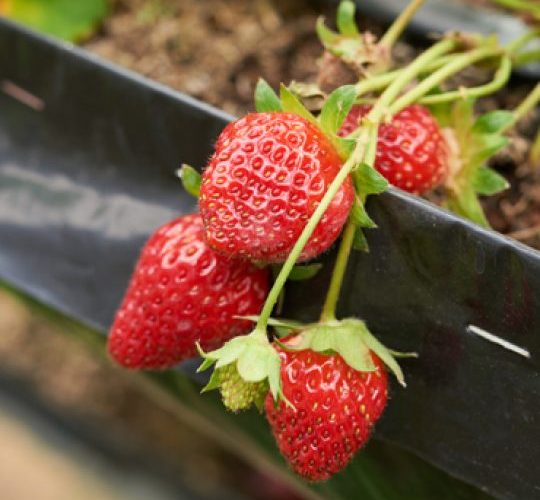
Introduction
The runners of strawberry cultivar “Chandler” may be sourced from Mangora (Swat) and transplanted at the intended farmland. Main varieties of strawberries cultivated in Pakistan are Chandeler, Corona, Douglas, Tufts, Gorella and Toro. Before transplantation, runners are dipped in fungicide (Ridomil Gold @ 2g/ liter of water) for 2 to 5 minutes. In Pakistan strawberry is being cultivated successfully in plains of Ghotki, Panu Akil, Ranipur, Shaheed Benazirabad, Gilgit Chitral, Kaghan Kohistan, Swat, Mingora, Multan, Narowal, Bhawalpur, Chishtian, Sialkot, Faisalabad and many other areas of Pakistan.
Duration And Yield
The approximate crop duration from land preparation to harvest is around 6.5 months. The estimated yield potential of the farm varies from 3-4 tons per acre.
Following Key Parameters Must Be Addressed As Per Pre-Feasibility Study Under Preparation:
Technology:
Generally, strawberry is cultivated on ridges at fertile soil with suitable drainage quality. Seedlings are transplanted on ridges and crop is irrigated on weekly or on need basis. Seedlings will be transplanted in mid of October 15th. The land preparations will be started in first week of October.

Production Process Flow
Site And Soil:
Strawberry requires a well-drained medium loam soil, rich in organic matter. The soil should be slightly acidic with pH from 5.8-6.5. At higher pH root formation is poor. The presence of excessive calcium in the soil causes yellowing of the leaves. Strawberry should not be cultivated in the same land for a number of years. It is preferable to plant it in green manure field. Alkaline soils and soils infected with nematodes should be avoided. It is generally cultivated on ridges or raised beds where the addition of organic matter will not only improve the soil but aid drainage.
Ploughing:
The first step for Strawberry cultivation is ploughing. The primary purpose of ploughing is to turn over the upper layer of the soil, bringing fresh nutrients to the surface, while burying weeds and the remains of previous crops and allowing them to break down.
Ridge Preparation:
Strawberries can be cultivated on raised beds of 10-12 inch high in the center after firming down and 24 inch wide should be constructed. The ridge should have an even curve and the soil broken down to a fine tilth which have the following advantages over conventional growing:
- Reduced risk of water-logging and soil-borne diseases.
- Increase in the available rooting depth on shallow soils.
- Early production of crops as warmth penetrates at a higher rate.
These Advantages In Turn Lead To Higher Yields.
Runners Bed Preparation:
In next step runners bed is prepared. The soil of a runners’ bed needs to be loose and smoothed, without large lumps, so that runners can be planted easily. Large lumps and uneven surface area would tend to make the planting depth random.
Soil Fertilizing:
Fertilizers are fertigated or spread in, as the next step. Plants need to be fertilized because in most cases, the soil does not provide the essential nutrients required for optimum growth.
Runners Transplanting:
The distance between the rows should be 20-24 inches and the distance between the plants should be 4-6 inches.
Weed Control:
Weeds are plants that grow where they are not wanted. Vigilant weeding measures keeps weeds from robbing valuable nutrients from the soil and competing with desired flowers, vegetables, herbs and shrubs. Weeds can also shelter harmful insects and diseases. Weeds can be effectively controlled by using mulch as well as through the use of weedicides like paraquat or pedimentharine.

Pest Control:
Insects can be controlled by preventive measures like spray or rotation of strawberry with other crops is useful in controlling insects.
Irrigation:
Since strawberry is relatively shallow-rooted, it is susceptible to conditions of drought. It is necessary to ensure that newly planted runners are irrigated frequently after planting, otherwise the mortality of the plants become high.
Harvesting:
Strawberries are ready for picking when the fruits develops color to that shade of red which is characteristic of that particular variety. They are best picked at this stage for eating fresh, freezing and making into jam; they will keep very satisfactorily for forty-eight hours in a domestic refrigerator at a temperature of 2°C (35°F).
Grading And Packing:
Strawberries are then sorted into grades according to their quality and packed accordingly. They should only be packed into shallow containers because in deeper containers lower tiers of fruit will be bruised by the weight of upper tier fruit pressing down on them.
Transportation:
Strawberries are highly perishable goods and a great deal of care in handling and marketing is required. Usually the fruit is packaged in the early morning and sent to the market in the afternoon of the same day or is picked in the late afternoon, stored overnight in a cool place, and sent to the market the following morning.
Critical Factors
The Main Critical Factors That Would Determine The Degree Of Success Of The Crop Are As Follows:
- Fertile land and its maintenance during the period of cultivation.
- Special attention towards plant health and healthy runners, land preparation, sowing pattern, water management, fertilizer application and marketing is required.
- Timely control of pests, diseases and implementation of all recommended agronomics measures.
- Appropriate post-harvest arrangement for washing, grading, packing and transportation of product to the market.
- Use of high quality hybrid seeds.
- Proper soil analysis for determining the level of nutrients in the soil.
- Farming should be done on scientific grounds, taking care of input requirements and optimal resource utilization.